EN


Suspension Clamp vs. Tension Clamp: What's the Difference and When to Use Each?
A suspension clamp supports an overhead cable at an intermediate attachment point, while a tension clamp anchors a cable and transfers longitudinal tensile forces to a supporting structure. In aerial bundled cable (ABC) networks, suspension clamps are generally used where the cable continues through a support, and tension clamps are used at terminations or designated anchoring points. The correct choice depends on cable construction, loading and approved line geometry.
What Is a Suspension Clamp?
A suspension clamp is a mechanical fitting that holds an aerial cable at a supporting structure while accommodating the loads specified for that support. It typically connects to a pole bracket through an attachment eye or other compatible interface. Its purpose is to maintain the cable's position and transfer the relevant support loads without compromising the cable insulation.
In a continuous overhead span arrangement, the cable approaches an intermediate pole from one direction and leaves in another. The suspension assembly carries the weight of the supported cable and may also experience transverse forces from wind, line deviation and unequal span loading. It should not be assumed to carry only vertical loads.
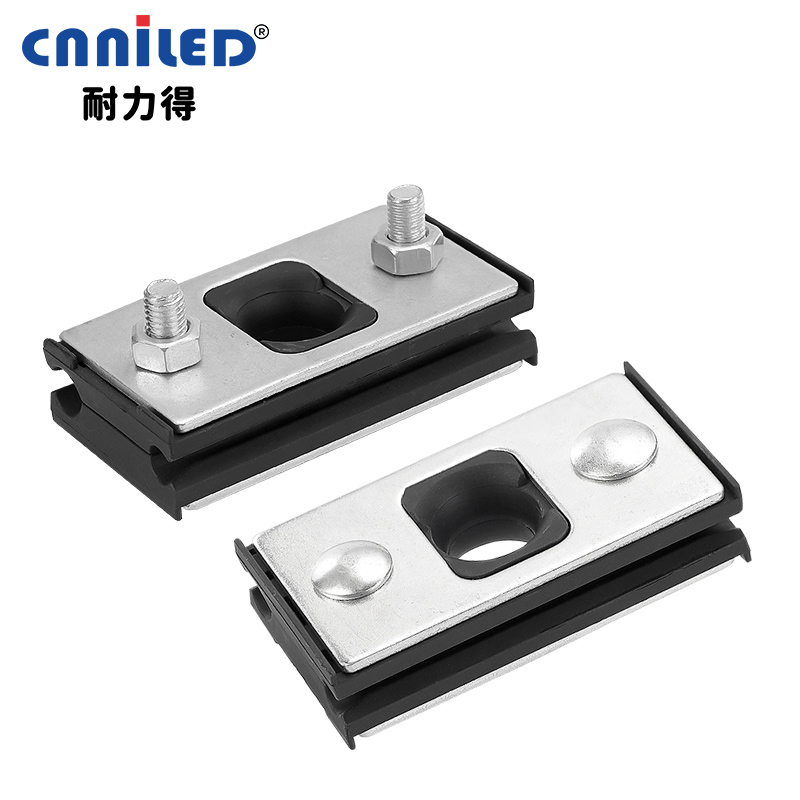
The CNNILED CS14 suspension clamp with bracket is an example of an ABC cable support assembly. It combines a shaped black cable-holding component with a metallic mounting bracket. The product is intended for compatible overhead ABC suspension points. The specific cable dimensions, allowable loads and deviation limits must be confirmed before choosing this model.
What Is a Tension Clamp?
A tension clamp is a mechanical fitting that restrains an aerial cable or its load-bearing messenger and transfers the specified tensile force into a pole, wall or other approved support. In overhead distribution systems, the fitting defines a mechanical anchoring point rather than simply holding the cable along a continuous route.
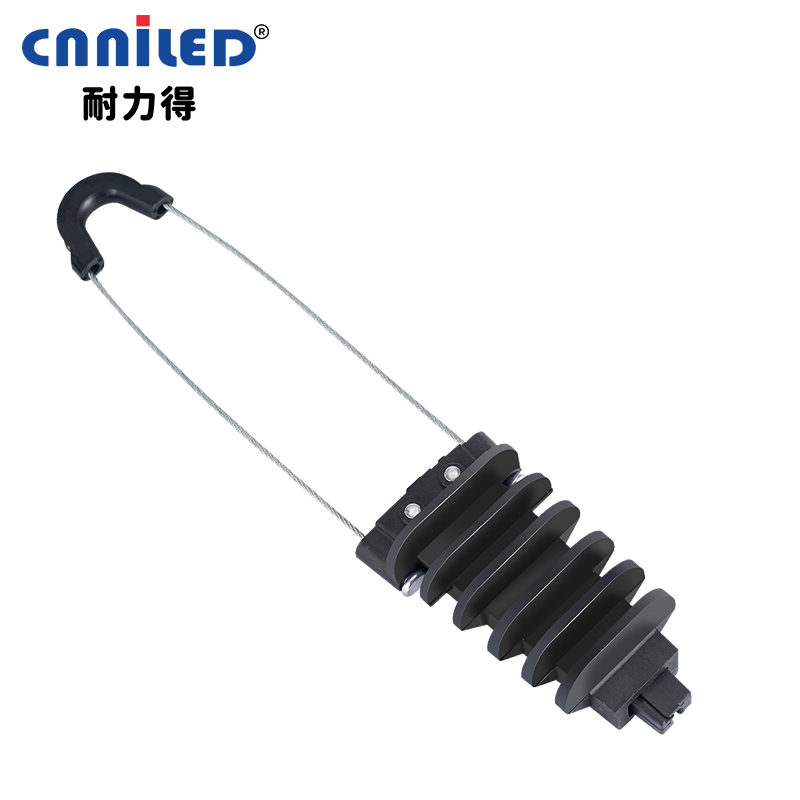
Wedge-type tension clamps commonly use gripping elements that engage a compatible cable within the clamp body. The grip develops as the assembly carries tension. A bail or attachment link connects the clamp to the supporting hardware. The gripping surfaces, cable dimensions and load rating must work together to avoid unacceptable slippage or insulation damage.
CNNILED's PA1500 tension clamp is a wedge-type product with a wire-rope attachment. Its catalog lists a clamping range of 50–70, a pulling force of 8 kN and a minimum order quantity of 2,000 pieces. The supplied product specification identifies the range in mm². Confirm the exact cable configuration and interpretation of the force rating before engineering approval.
The terms anchoring clamp, dead-end clamp and tension clamp frequently refer to similar functions in ABC systems. However, terminology varies between utilities, manufacturers and countries. A model described as a strain clamp for a bare conductor is not automatically suitable for insulated bundled cables.
Suspension Clamp vs. Tension Clamp: Key Differences
The most important distinction is the intended load path. A suspension assembly supports a continuing cable; an anchoring assembly transfers the specified longitudinal tension to the structure. The following comparison summarizes typical design roles rather than universal product ratings.
|
Selection factor |
Suspension clamp |
Tension clamp |
|
Primary function |
Support continuing cable |
Anchor cable or messenger |
|
Mechanical loads |
Weight and specified transverse or other loads |
Specified longitudinal tension and resultant loads |
|
Typical location |
Intermediate supports |
Terminations and designated anchors |
|
Cable interface |
Support and retention |
Mechanical grip resisting axial movement |
|
Selection inputs |
Cable dimensions, support loads, deviation |
Cable dimensions, tension, grip and load rating |
|
Installation checks |
Bracket, retention and clearances |
Grip, bail, bracket and anchor capacity |
|
CNNILED example |
CS14 |
PA1500 |
Where Are Suspension and Tension Clamps Used?
Intermediate poles: On straight or suitably limited deviation sections, a suspension clamp can support the cable while allowing the route to continue. The engineer must consider the supported span lengths, clearance requirements and the combined loading at the pole.
Terminal poles: At the end of a mechanically tensioned section, a tension clamp normally transfers cable tension to the supporting structure. The bracket, pole and fixing hardware must be capable of carrying the resulting load as a complete assembly.
Angle poles: A change of direction introduces a transverse resultant even when tensions in adjacent spans are similar. Small deviations may be accommodated by an approved suspension arrangement. Larger deviations or particular loading conditions may require a designed anchoring arrangement. There is no universal permissible angle for all clamp models.
Section and branch points: Utilities may divide a route into mechanically independent sections to satisfy design or maintenance objectives. These locations may require anchoring assemblies even when the route is geographically straight. Electrical continuity and mechanical anchoring are separate design requirements.
How to Choose the Right Clamp for ABC Cables
1. Identify the load-bearing cable component. Determine whether the ABC is self-supporting or uses a dedicated neutral messenger. A clamp intended to grip an entire bundle may not be appropriate for a messenger-only system. Request the cable construction drawing rather than relying only on the nominal phase conductor size.
2. Check physical dimensions. Record conductor cross-sectional area in mm² and the actual external diameter in mm, including insulation where relevant. Two cables with identical conductor areas can have different outside dimensions. Confirm both against the fitting manufacturer's approved compatibility range.
3. Establish mechanical requirements. Use the project's calculated loads, including the effects of span length, sag, temperature, wind and other applicable environmental conditions. Distinguish working load, test load and minimum breaking load. A catalog pulling-force figure is not automatically an allowable working load.
4. Review pole configuration and geometry. Identify straight supports, angle supports, section anchors and terminations on the route drawing. Check bracket orientation, attachment clearance and fixing compatibility. The pole and its hardware must be evaluated together, not as unrelated components.
5. Consider environmental exposure. Coastal salt, ultraviolet exposure, temperature cycling and industrial pollution can influence material selection. Request evidence appropriate to the intended service environment rather than assuming a black polymer body or metallic bracket has a particular durability rating.
6. Verify material and insulation compatibility. The gripping arrangement must be appropriate for the cable insulation and load-bearing component. Confirm that the manufacturer approves the specific cable construction; appearance and nominal size alone are insufficient evidence.
7. Match the project specification. BS EN 50483-2:2026 addresses testing of fittings for self-supporting low-voltage ABC systems, while BS EN 50483-3:2026 addresses neutral-messenger systems. Consult the applicable contractual edition and local utility requirements. These references describe relevant test frameworks, not proof that a particular CNNILED product has passed them.
CNNILED Suspension and Tension Clamp Solutions
CS14 Suspension Clamp with Bracket
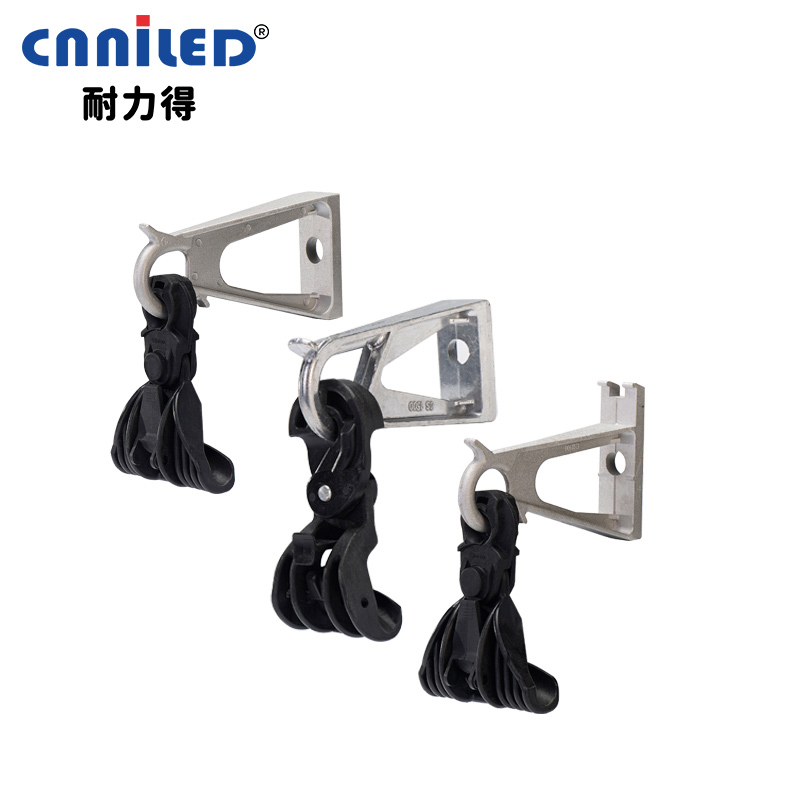
CNNILED CS14 suspension clamp with triangular mounting bracket
The CS14 is intended for overhead ABC suspension and is supplied as a clamp-and-bracket configuration. Its published minimum order quantity is 2,000 pieces. For a distributor or utility contractor, the integrated configuration provides a useful starting point when specifying the mechanical interface between the cable and its support.
Before ordering, request the approved cable dimension range, mechanical ratings, allowable installation geometry and bracket fixing details. The current public product table does not state these numerical limits, so they should not be inferred from the photographs. Review the CS14 product page for the published configuration and inquiry options.
PA1500 Tension Clamp
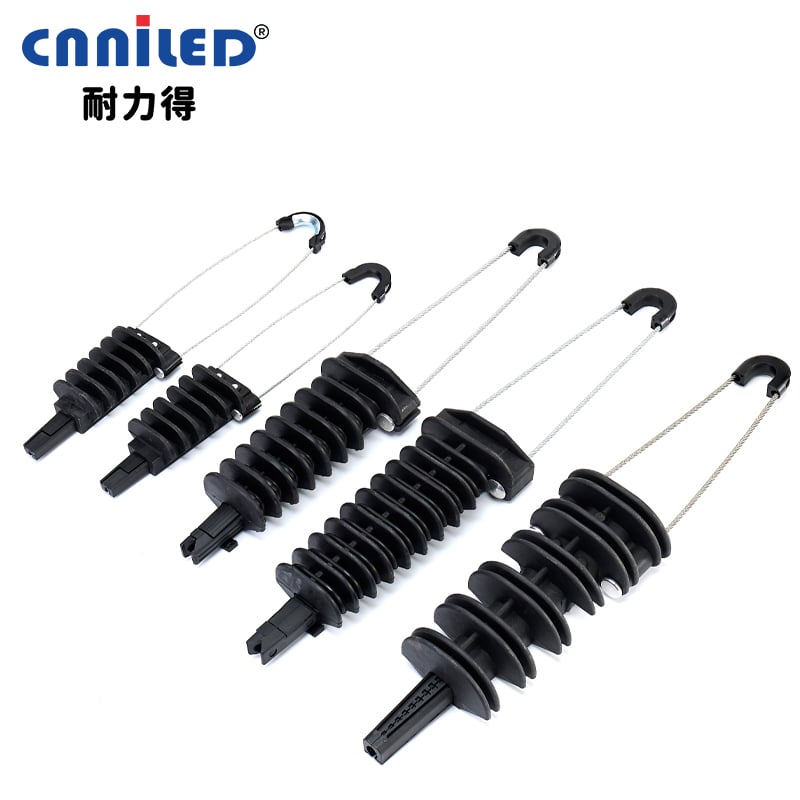
CNNILED PA1500 wedge-type tension clamp with wire-rope bail
The PA1500 is intended for mechanical anchoring of compatible aerial cables. The supplied product information describes a wedge design and stainless steel wire rope. The published pulling-force figure is 8 kN, and the stated conductor range in the supplied specification is 50–70 mm². The minimum order quantity is 2,000 pieces.
For an engineering purchase, obtain confirmation of the actual cable outside diameter, whether the clamp grips the messenger or another load-bearing component, and the meaning of the 8 kN figure. Request model-specific test documentation where the project requires it. See the PA1500 product page and the related anchoring clamp selection guide.
Common Mistakes When Selecting Overhead Cable Clamps
Selecting by nominal conductor area alone can result in a clamp that does not fit the insulated cable correctly. A second common mistake is assuming that a suspension clamp can replace a tension clamp because both attach to a pole bracket. Their intended load-transfer functions differ.
Another procurement risk is comparing force ratings without checking their definitions. A breaking load from one supplier and a working load from another cannot be compared as equivalent values. Similarly, a certificate for a manufacturer's quality management system does not establish the performance of an individual clamp model.
Finally, avoid selecting solely on unit price. An incomplete specification can lead to incompatible hardware, replacement costs and delays during project acceptance. Obtain drawings, cable compatibility information, required test evidence and installation instructions before approving a bulk order. Installation and inspection should be performed by qualified personnel under the approved utility procedures.
Frequently Asked Questions
What is the difference between a suspension clamp and a tension clamp?
A suspension clamp supports an aerial cable at a continuing support point and carries the specified support loads. A tension clamp anchors the cable or messenger and transfers longitudinal tensile force to the supporting structure. The correct choice follows the mechanical design of the line, not simply the appearance of the fitting.
Can a suspension clamp replace a tension clamp?
Generally, no. A suspension clamp should not replace an anchoring fitting unless that exact configuration has been engineered and approved for the required load and service conditions. Even where two clamps accept the same cable size, their load ratings, gripping mechanisms and intended functions may differ.
Where are suspension clamps installed?
Suspension clamps are commonly installed at intermediate supports along overhead distribution routes. Some models are suitable for limited line deviations, subject to the manufacturer's approved geometry and the utility's loading requirements. Larger angles and mechanically independent sections may require anchoring hardware instead.
What is a dead-end clamp used for?
A dead-end clamp mechanically terminates a tensioned cable section and transfers its tensile force to an approved supporting structure. Typical applications include terminal poles and designated section anchors. The fitting does not necessarily terminate the electrical circuit; a separate electrical connection or jumper may preserve electrical continuity.
Are anchoring clamps and tension clamps the same?
In ABC procurement, these names often describe fittings with the same basic mechanical anchoring function. However, product naming is not a substitute for technical identification. Buyers should confirm the precise model, cable compatibility, load definition and applicable standard rather than treating every product with either name as interchangeable.
How do I select the correct clamp for ABC cables?
Start with the cable construction, load-bearing component, conductor area and insulated outside diameter. Next, identify the support function and calculated mechanical loads. Check the fitting's dimensions, declared load capacity, bracket interface and test documentation against the utility's requirements before final approval.
What conductor sizes does the CNNILED PA1500 support?
The supplied CNNILED specification identifies a range of 50–70 mm² and the website lists a pulling force of 8 kN. Buyers should confirm the cable type, actual outside diameter and interpretation of that force rating with CNNILED. The nominal range alone does not establish suitability for every ABC design.
Where can I source suspension and tension clamps for wholesale orders?
CNNILED offers overhead electrical line fittings, including the CS14 suspension clamp and PA1500 tension clamp, each with a listed MOQ of 2,000 pieces. International distributors and project buyers can submit cable drawings, required quantities, mechanical requirements and applicable standards through the company's contact page to request a quotation.
Conclusion
The distinction between suspension and tension clamps is fundamental to overhead ABC network design. Suspension fittings support continuing cable runs, while tension fittings establish mechanical anchoring points. Select each model using cable compatibility, verified loading data, support geometry and project requirements. Contact CNNILED for product specifications, selection assistance and bulk quotations for your next overhead distribution project.
Technical references
 Hot News